stack-and-knocklive
Pithooपिट्ठू गरम
India · Pakistan
Knock the tower, then rebuild it before you're tagged
Seven flat stones, an old tennis ball, grass-stained shins. Every Indian schoolyard had its tower, and its shout when the stones came back.
 NotSoSure · Games of memory
A world atlas of the games we played in the dirt: chalk grids, marbles, kites and boards, rebuilt as browser-playable demos so a kid in Mississauga and her grandfather in Lucknow can play the same round.
◍ The day passes over the courtyard
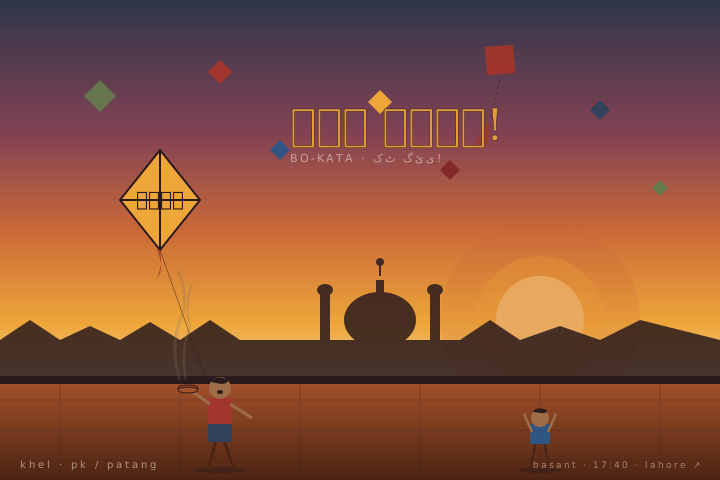
Lahore rooftop · sunset
the spool spins, the sky fills with strings
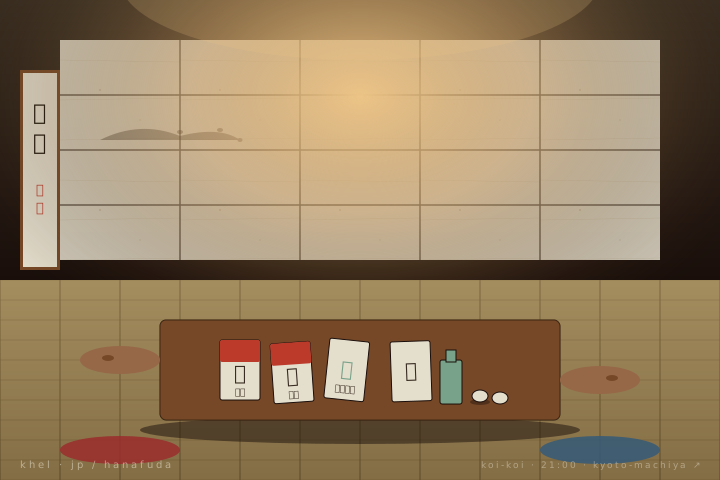
Tatami room · night
flower cards under a paper lamp
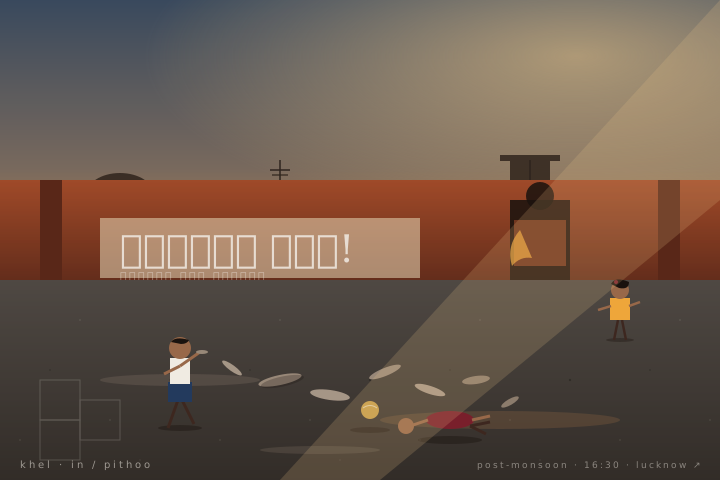
Post-monsoon courtyard · Lucknow
wet concrete, scattered stones, a grandmother on the verandah
These games are vanishing. Urbanisation eats the maidans; cricket and phones absorb the rest. Khel is not a replacement (nothing replaces a dirt boundary line) but a way to keep them playable, and remembered.
Each game ships with its real story: the boric-powder smell of a Carrom afternoon, the cantor's sung rhymes at a Guadalajara fiesta, the shout of “Pithoo!” when the stones come back into a stack. Voice rooms are mandatory. Without the noise, a game is a husk of itself.
The catalogue spans ~50 countries in 24 cultural clusters, each rebuilt as a physics-driven 3D arena. We started with one game, one scope, then let everything compound from there.
The catalogue is organised the way memory is, not by continent but by the cultures that share a courtyard. Twenty-four clusters reach across roughly fifty countries, and a game can belong to many at once: Carrom is South Asian, Pithoo is shared across a border, Pétanque carries from France into Italy and Spain.
Each one is a real physics-driven demo: the strike, the flick, the throw modelled from how the game is actually played. Tap a tile to read its story; the live build is one tap further.
India · Pakistan
Knock the tower, then rebuild it before you're tagged
Seven flat stones, an old tennis ball, grass-stained shins. Every Indian schoolyard had its tower, and its shout when the stones came back.

South Asia
Flick the striker, cover the Queen
The board lived on the fridge, the boric powder in a steel dabba. The clack of a striker on a coin is one of the most specific sounds in South Asian memory.
USA · Canada
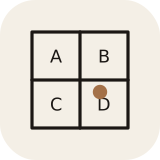
Slap-bounce, survive, rotate up to King
Yellow-painted blacktop, a red rubber ball, a line of fourth-graders. The King's reign is temporary: everyone gets a turn, the line always moves.

México
The cantor sings the card, you mark it with a bean
Mexican bingo, but to call it bingo misses everything: a 54-card picture deck, sung rhyming calls, and twenty cousins around three folding tables.

Lahore · Ahmedabad
Let the line out, cut the rival kite from the sky
Rooftops at sunset, the spool spinning, the marigold paper climbing. A whole sky becomes a duel of strings stretched taut against the dusk.
Egypt
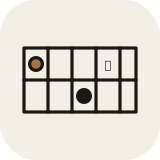
Throw the casting sticks, race across the thirty squares
Painted into the tombs of pharaohs: the oldest board we rebuilt. Thirty squares, casting sticks for dice, and a journey the ancients took to mean the afterlife.
Nothing here is bought off a shelf. A game travels the same four steps every time, and a piece is only finished when it clacks the way it did in your hand.
Before a single piece is modelled, a regional editor authors the game's real memory: the smell, the shout, the exact way it was played. Sensitivity flags are set here, indigenous games get a reviewer from the culture itself.
The board, the striker, the seven flat stones, the marigold kite. Real objects rebuilt as 3D pieces, not bought off a shelf. The atlas already holds 60+ of them, from a Bao board to a Senet fragment.
The flick, the bounce, the spin, the throw, modelled from how the game actually moves, so a striker clacks and a top wobbles the way they should. This is what makes a demo playable instead of a picture.
Voice rooms are mandatory, not a feature. Without the cantor's sung calls, the shout of Pithoo, the table's groan, a game is a husk of itself. The noise is half the game, so the noise ships with it.
Play across timezones
A game of memory is not much use if you only remember it. So the atlas is built for the diaspora first: the round is shared, the voice room is open, and the clock between two cities stops mattering.
the grandchild, after school
the grandfather, on the verandah
◍ Live at khel-web.vercel.app
The same round, for a kid in Mississauga and her grandfather in Lucknow. Six games are playable in the browser today, and the atlas keeps growing, one game of memory at a time.